
















Wedge Anchors: Technical Overview, Use Cases & Comparison
What is a Wedge Anchor
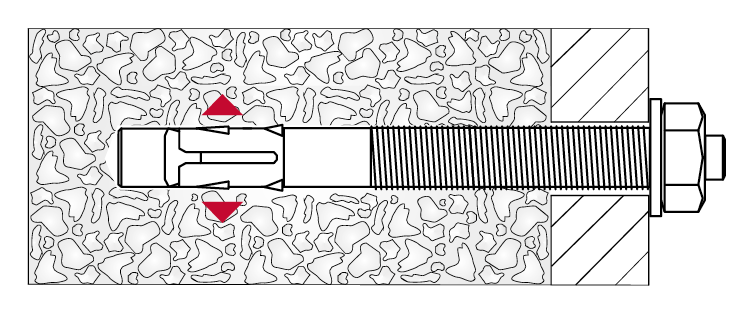
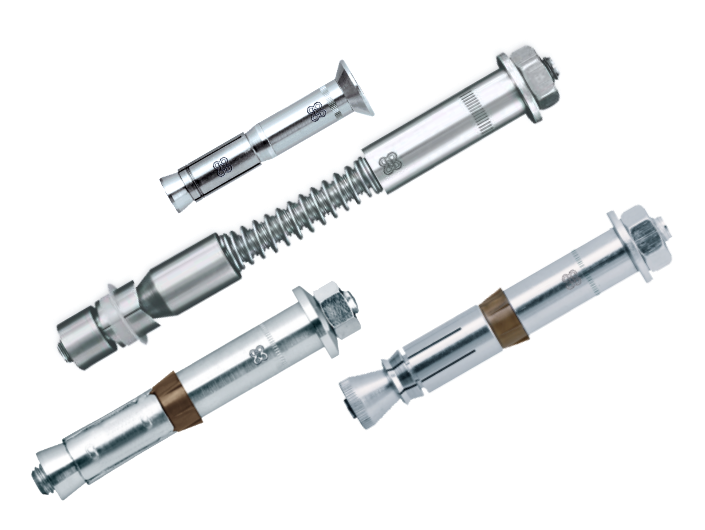
A wedge anchor is a type of mechanical expansion anchor used to fasten structural or heavy-duty elements into concrete. It consists of a threaded rod (bolt) with a tapered or wedge-shaped end, a sleeve or clip around the wedge, a nut and washer. Once a correctly-sized hole is drilled in concrete, the anchor is inserted, and as the nut is tightened, the wedge is driven up into the sleeve or clip — expanding against the walls of the hole. This mechanical expansion creates a strong radial pressure and frictional grip, embedding the anchor securely in the concrete.
Because the anchor depends on mechanical expansion into solid concrete, wedge anchors are best suited to solid concrete substrates — as opposed to hollow block, lightweight block, or masonry with voids, where expansion anchors may not achieve full, reliable grip.
Wedge anchors along with other expansion-type fasteners — are part of a wider classification of mechanical anchors (e.g mechanical anchor bolt, mechanical expansion anchor or mechanical anchor fastener) in concrete construction.
Types & Variants of Wedge Anchors
While “wedge anchor” often refers to a standard through-bolt expansion anchor for concrete, there are variations in design, materials, head types, and applications. Key distinctions include:
- Standard concrete wedge anchor (through-bolt) — the classic design: a bolt with a wedge at the end, expansion sleeve/clip, nut and washer; appropriate for solid concrete and heavy-duty loads.
- Mechanical anchor bolts with different head types or lengths — depending on embedment depth, load requirements, and fixture geometry (e.g. hex head, heavy-duty bolts, long rod, etc.).
- Through-bolting vs flush/embedded variants — some wedge anchors are used where a bolt must pass entirely through a fixture and nut on the other side (through-bolting), while others are used where the bolt is embedded and only the threaded end remains for fixture attachment.
When specifying wedge anchors, engineers must consider substrate (solid concrete), anchor material (carbon steel, stainless steel), embedment depth, expected loads (tension, shear), loading conditions (static, dynamic, vibration), and exposure environment (indoor, outdoor, corrosive, moisture).
Wedge Anchors vs Sleeve Anchors (e.g. LIEBIG Safety Bolt / Anchor) — Key Differences & When to Use Each
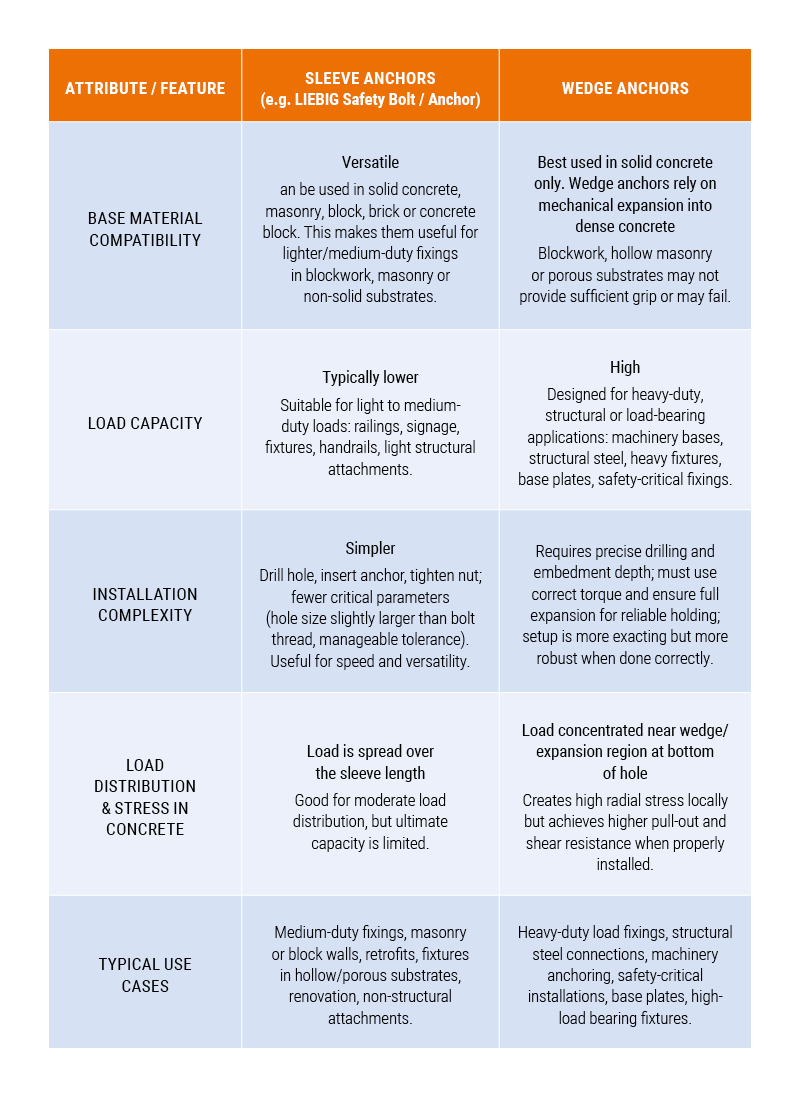
Although both wedge and sleeve anchors belong to the broader family of mechanical expansion anchors, their design differences lead to distinct applications, performance, and suitability.
Conclusion (when to use what):
Use sleeve anchors when versatility, ease of installation, and compatibility with block/masonry or mixed substrates is required — for medium / non-structural loads.
Use wedge anchors when working with solid concrete and expecting high loads, structural attachments, heavy machinery, or safety-critical fixings — where strength and reliability matter most.

Applications — Where Wedge Anchors Excel
Given their strength and reliability, wedge anchors (concrete wedge anchors / mechanical anchor bolts) are widely used in situations such as:
- Anchoring structural steel base plates to concrete foundations or floors.
- Fixing medium to loads, machinery, equipment, or heavy racks to concrete slabs or walls (industrial floors, factories, warehouses).
- Mounting safety-critical components — guardrails, safety barriers, structural supports, load-bearing beams.
- Attachments where high shear or pull-out resistance is required (e.g. bolts in structural elements, facade fixings, heavy-duty wall connections).
- Installations where long-term durability is needed — especially when combined with corrosion-resistant materials (e.g. HCR wedge anchors) for outdoor or harsh environments.
Because wedge anchors are a type of mechanical expansion anchor, they belong to the broader category of mechanical anchors for concrete (mechanical anchor fastener / mechanical anchor bolt / mechanical expansion anchors).


Benefits of Wedge Anchors (Advantages over Other Anchor Types)
High tensile and shear strength: ideal for medium to or structural load-bearing applications.
Reliability in solid concrete: because of mechanical expansion and tight wedge engagement, they deliver consistent performance when installed properly.
Durability and long-term performance: especially when specified in stainless steel, wedge anchors are more resistant to corrosion, making them suitable for exposed, outdoor, or high-moisture environments.
Well-suited for structural fixings or applications: their higher load-bearing capacity and robustness makes them appropriate for key structural fixings, heavy equipment anchoring, or long-term installations.
Mechanical anchor solution: no chemicals required unlike adhesive anchors; installation is simpler (no curing) and immediate load application is often possible (after torque). This can be advantageous for speedy construction or retrofit work.
Wedge Anchors vs Concrete Undercut Anchors (e.g. LIEBIG Superplus BLS)
While wedge anchors are a robust mechanical expansion solution, undercut anchors represent a more advanced anchor category, offering performance advantages in certain demanding scenarios.
Mechanism difference: Undercut anchors do not rely solely on radial expansion and friction. Instead, they create or use a pre-cut “key” or undercut in the concrete, into which the anchor locks — producing a mechanical interlock rather than friction-based hold. This reduces excessive stress zones in the concrete caused by expansion, while enabling higher tensile and shear performance.
Performance / Load capacity: Because loads are transferred by bearing in the concrete undercut — similar to cast-in-place studs — undercut anchors generally offer higher load capacity, better performance under dynamic or cyclic loads (vibrations, seismic, shock) and greater resistance in cracked or aged concrete.
Reduced concrete stress and better spacing: Undercut anchors do not produce high outward radial stress, meaning they can be installed closer to edges or other anchors, and are less likely to cause concrete splitting or cone failures.
When undercut may be preferable to wedge: structural steel fixings, heavy machinery, seismic zones, dynamic load environments, cracked or deteriorating concrete, heavy-use industrial or infrastructure works where safety & longevity are critical.
Therefore, while wedge anchors remain a very capable mechanical anchor — especially for heavy static loads in good, solid concrete — undercut anchors (e.g. LIEBIG Superplus BLS) are often a superior choice when higher performance, safety factor, dynamic load resistance, or harsh environmental conditions are required.
Practical Considerations & Installation Best Practices (for Engineers & Specifiers)
When using wedge anchors (or choosing between anchor types), consider the following carefully:
- Substrate condition: Ensure you have solid, dense, crack-free concrete of adequate thickness and strength. Wedge anchors are not appropriate for hollow blocks, light masonry, or weak masonry.
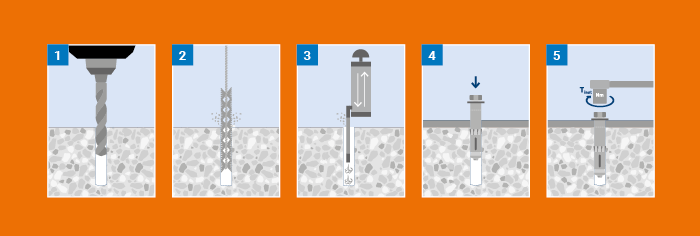
- Drill hole quality and depth: Use proper drill bit, hammer drill, correct diameter and depth. Hole must be cleaned of dust and debris (vacuum or compressed air) to ensure full wedge engagement and expansion.
- Embedment depth & edge/spacing requirements: Follow anchor manufacturer’s specifications; insufficient embedment or too-close edge/anchor spacing can severely reduce load capacity or cause concrete failure (e.g. cone/spalling, edge splitting).
- Material and corrosion resistance: For outdoor, moisture-prone, or corrosive environments, specify stainless steel wedge anchors to reduce corrosion risks and prolong service life.
- Load type and dynamic stresses: For purely static loads wedge anchors perform well. But if there are dynamic loads — vibration, seismic, cyclic loads — consider whether a mechanical expansion anchor is adequate, or if an undercut anchor (or adhesive anchor) is safer.
- Safety factor & engineering code compliance: Ensure that anchor selection, embedment, spacing, and load calculations follow relevant codes/standards. When in doubt, specify a more robust anchor (e.g. undercut anchor) rather than stretching a wedge anchor to its limits.
Summary & Recommendations
Wedge anchors are a highly effective mechanical anchor solution when used appropriately: solid concrete, heavy-duty loads, structural or safety-critical fixings, or heavy machinery anchoring. They deliver high tensile and shear capacity, long-term durability (especially stainless variants), and reliability when installed correctly.
However, for masonry, blockwork, lighter loadings, or retrofit/masonry-fastening tasks, other anchors — such as sleeve anchors (e.g. LIEBIG Safety Bolt / Anchor) remain more versatile. For conditions where maximum load, dynamic or seismic stress, cracked concrete, or edge-spacing limitations exist, undercut anchors (e.g. LIEBIG Superplus BLS) often offer superior performance due to their mechanical key-lock mechanism rather than relying solely on expansion.
In specifying anchors for concrete construction, the choice should always be based on load requirements, substrate, environmental conditions, and service life expectations. Wedge anchors remain a “go-to” for many high-load, structural tasks but they are one tool among many, and engineers should assess their use case carefully before application.
Featured Product in this article
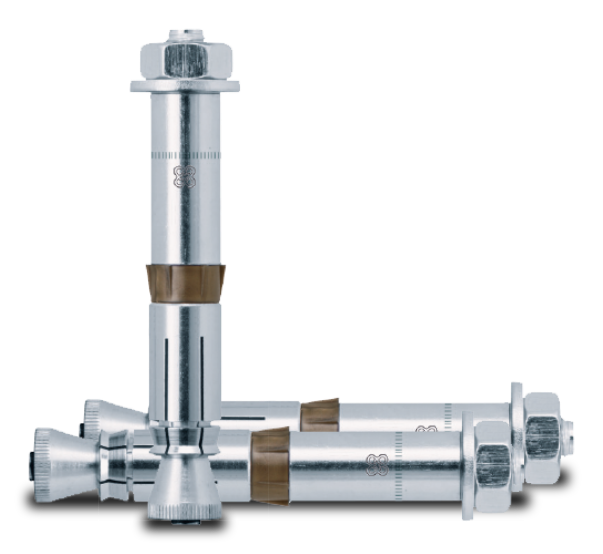
Super Plus BLS
- Self undercutting anchor ETA approved
- Size range M6-M16
- for cracked and non cracked concrete
Frequently Asked Questions
What is a wedge anchor and how does it differ from other anchor types?
A wedge anchor is a mechanical expansion anchor that secures in concrete by driving a wedge into a sleeve — as the nut is tightened, the wedge expands and grips the hole walls. Unlike adhesive or chemical anchors, it relies purely on mechanical friction/expansion; unlike undercut anchors, it does not mechanically interlock with the substrate.
Can wedge anchors be used in concrete block or masonry?
Generally no, wedge anchors perform best in solid concrete. For blockwork, masonry, or hollow substrates, mechanical expansion may not create reliable grip; in those cases sleeve anchors or alternative anchor types are more appropriate.
Are stainless steel wedge anchors better than standard anchors?
Yes, if the installation environment is outdoors, moist, chemically aggressive, or exposed to weather, specifying stainless steel wedge anchors improves corrosion resistance and long-term durability.
When should I choose a wedge anchor over a sleeve anchor?
Choose a wedge anchor when you require high load-bearing capacity, structural strength, or heavy-duty fixings in solid concrete. E.g. base plates, heavy machinery, structural steel attachments, or safety-critical fixtures. Sleeve anchors are more suitable for light/medium loads, blockwork, or masonry.
What are the advantages of undercut anchors compared to wedge anchors?
Undercut anchors (like the LIEBIG Superplus BLS) create a mechanical interlock within the concrete, giving superior tensile and shear performance, less stress on the concrete, better behaviour in cracked concrete, and more resilience under dynamic or seismic loading making them often preferable for heavy-duty or safety-critical installations.
What are the key installation best practices for wedge anchors?
Drill correct diameter and depth hole in solid concrete
Clean hole thoroughly (vacuum/compressed air)
Ensure correct embedment depth and spacing from edges / other anchors
Use correct torque on nut for full expansion
Choose anchor material suitable for the environment (e.g. stainless steel for corrosive/ outdoor)